jueves, 4 de abril de 2024

THEORY OF SPECIAL RELATIVITY - A MISINTERPRETATION THAT LEADS TO NONSENSE

PRESENTATION

Although in previous studies published in our Blog, we have used the ideas that we will now comment on, we believe that it will be interesting to combine these concepts and highlight the mistaken idea that has led to accepting the Theory of Special Relativity as valid.

We remember that one of the texts that we have taken as a basis for our criticism is A. Einstein's book entitled: “On the theory of special and general relativity.


AN ERROR THAT CAUSES A SHOOTING

We will first expose an error of interpretation in the mental experiments proposed by A. Einstein to demonstrate his theory, whose interpretation leads to the absurdity of having to accept a transmutation of matter.


1.- THE ERROR OF IDENTIFYING THE VISION OF A PHYSICAL PHENOMENON WITH THE CHANGE IN NATURE OF THE SAME

In one of our previous essays we said the following:

“In the mental experiments taken from the aforementioned book by

Einstein, we will accept his conclusion as valid using the verb SEE instead of using the verb BE that the author uses in his approach and conclusion.

By this we mean that we agree that the physical phenomena that occur within a Mobile Reference System (MRS) when OBSERVED from another Fixed Reference System (RFS) can BE modified. This modification will affect the VISION dimension of its duration, or the dimension of its mass. But what we do not accept is the use of the verb SER. We should not interpret that the phenomenon that occurs within the Mobile Reference System (SRM) when observed from the Fixed Reference System (SRF) has been transformed”

We can say the same if the physical phenomenon occurs within a Fixed Reference System (SRF) and is SEEN or observed from a Mobile Reference System (SRM).

The following figure is the typical drawing in which a train car appears moving at a constant speed. There is a mirror on the ceiling. A person inside the car shoots a beam of light at the mirror. This ray is reflected in the mirror and returns to its place of origin.


This phenomenon of reflection of the light ray serves to confuse analysts of the subject of relativity of movements, to say that the duration of the path of the rebound of the light ray, for the person who is outside the car (SRF), is has lengthened with respect to the peron that is inside (SRM) and that has fired the beam.

The person outside the car (SRF) SEES the lengthening of the beam path. His SUBJECTIVE opinion is that he believes that the duration of the ray's path has lengthened. But this would be confusing the verb SEE with the verb BE.

The physical phenomenon of this reflection of the light ray has a single Proper Time (tp). For the ground-fixed observer (SRF) its

Rating will depend on the speed of the wagon. But, we repeat: We should not interpret that the phenomenon that occurs within the Mobile Recency System (SRM) when observed from the Fixed Reference System (SRF) has been transformed.

"THE METAPHOR OF THE THEORY OF SPECIAL RELATIVITY"

We now include a drawing that we devised and published in one of our studios to make a simile with the erroneous acceptance of the Theory of Relativity.

The drawing wants to materialize and represent the vision in a deformed mirror of the image that I intend to SEE. It is intended to be a comparison with the acceptance of the fallacies preached by the Theory of Special Relativity.
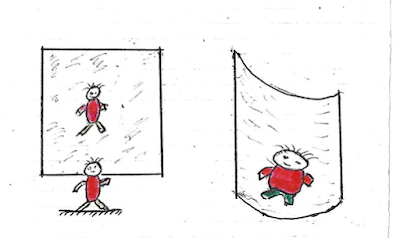


Following this theory makes us look in a convex mirror that distorts our ideas just as it would our image. We must look at ourselves in a flat mirror to really see our image and not believe in the “miracle” of transmutations. It is about SEEING correctly and not attributing to BEING what you SEE.

(In the previously mentioned case of the train car, it is its movement and its displacement that are equivalent to the concave mirror)


2.- THE ERROR OF TRYING TO FIND A DIFFERENCE BETWEEN TWO IDENTICAL AND SIMULTANEOUS EVENTS

In the aforementioned book by A. Einstein, in one of his epigraphs he exposes the topic of: The relativity of simultaneity. To which we criticize and say: “the error of the relativity of simultaneity.”

In the present study we criticize the conclusion drawn from the mental experiment presented by A. Einstein, in which he associates relative movements with events that are SIMULTANEOUS.

The WRONG conclusion that A. Einstein draws from this experiment, we will see, is the basis of the fallacy that we will discuss in the next issue.

We comment below on the mental experiment with which he intends to justify that two events that occur simultaneously ARE different depending on whether they are observed from the (SRF) or from the (SRM). We insist on stating that they WILL look different, but this does not mean that they change the quality of SIMULTANEOUSNESS that they have at the beginning of their production.

He asks in his book:

“Two events, for example, two lightning bolts (A) and (B), which are simultaneous with respect to the embankment, are

also simultaneous with respect to the train?”

(Refers to the embankment located on the tracks where the train car circulates)

And he goes on to say:

“…When we say that rays (A) and (B) are simultaneous with respect to the paths, we mean that the rays of light that leave places (A) and (B) meet at the midpoint (M) of the section of road (A)-(B). Now, do events (A) and (B) also correspond in places (A) and (B) on the train?

In order to better understand this question that A. Einstein asks, we have designed a drawing that represents a diagram of the mental experiment and its result.

The following drawing presents three phases of the wagon's progress. In it we make appear the two LIGHTNING FLASHES (A) and (B) and the RAYS OF LIGHT (A') and (B') that emerge from it


In this drawing we have made the rays reach the ground and we have drawn a person at the midpoint (M') of the distance between the rays.

As it appears in the drawing, and based on Einstein's conclusion, the person who is on the ground perceives the arrival of the light from the two simultaneous rays at the same moment, while the person who is riding the train perceives it sooner. the ray (B) than the ray (A). With this argument he affirms that the phenomenon of SIMULTANEOUSNESS IS different contemplated from the (SRF) than contemplated from the (SRM)

Here he makes the mistake that we have already mentioned and that the phenomenon is not deformed. In this case the SIMULTANEOUSNESS of the two events.

We can add that the relative movement to which the physical phenomenon is subjected deforms the VISION of the quality of the event. But the reality is that a SIMULTANEOUS circumstance (or let's call it phenomenon) has occurred. And this is what the person fixed on the ground (SRF) will judge.

Let us note that we are now presenting an inverse case to the one we had presented in the previous issue. There the phenomenon had occurred inside the car and it was the person who was on the outside of it (SRF) who SAW the phenomenon deformed, while the person who was inside (SRM) was the one who could really appreciate the phenomenon.

In the case that we are now discussing, the event occurs outside the carriage and it is the person inside it who WOULD see the SIMULTANEOUSNESS of the event distorted. It is the person who is outside (SRF) who can appreciate the circumstance of simultaneity as it IS.

Taking into account that the relative movement considered in the aforementioned mental experiments is nothing more than a disturbing effect of the VISION of the phenomenon, as we have seen we can consider examples where the quality of SIMULTANEOUSNESS of two events can occur both outside (SRF) as within the (SRM).

We give another example of a SIMULTANEOUSNESS phenomenon in which this circumstance occurs within the (SRM). We have devised a thought experiment, with relative movements between the train car and a fixed observer outside the car, and where the event of SIMULTANEOUSNESS occurs inside the car.


The drawing represents three phases of advance of a wagon that goes at a straight and constant speed.

In the center of the car there is a person holding a dough in each of his hands. The masses have equal weight. Outside the car there is a fixed observer on the ground (SRF).

Due to the movement of the wagon, at the moment that the person inside passes in front of the observer who is on the ground, that person releases the two masses at the same time. We consider this as a SIMULTANEOUS event.

We observe that in the intermediate step of the drawing it is seen that the masses have not yet touched the floor of the car. In the last stage represented by the drawing, the masses have already arrived on the ground. This is what the observer WOULD SEE (SRF)

The observer who is fixed on the ground (SRF) WILL SEE the different phases in which the masses fall, in the different phases of the wagon's advance.

The (SRF) WILL SEE the fall in each of the stages, while the (SRM) will consider a free fall.

It is evident that the SIMULTANEOUS fall of the two masses has not been transformed for the (SRF). YOU WILL SEE it deformed. It is the same thing that we had commented on the phenomenon of reflection in the mirror of the ray of light.


3.- THE PARADOX OF TRANSMUTATION

To help interpret and understand the metaphorical meaning given to the title of this issue, we transcribe the following definition and explanation: “PARADOX: Fact or saying contrary to logic.” “TRANSMUTATION: It involves the change of atomic nuclei. “It changes one element into another.”

The physicist A. Einstein, in his confusion of SEEING with BEING when dealing with the Relativity of Simultaneity, believes that an event produced in a (SRM) should not be IDENTIFY from an (SRF). And, in his aforementioned book, he mentions the following statement:

“The time needed for a process with respect to the wagon cannot be equated to the duration of the same process judged from the reference body of the embankment”

And, here the nonsense or the Paradox of Transmutation is born.

This is where we say that his statement is equivalent to the “miracle of transmutation. It does not admit that it LOOKS different but that it IS different.

Now he seems to forget the First Principle of relativity. He now speaks of “a” process “and not of the laws that govern natural phenomena. The confusion that he makes on the issue of the “relativity of simultaneity” makes him interpret the vision from the (SRF) of the events that occurred in the (SRM) differently.

To finish, we only need to remember the well-known “twin brother paradox”, in which the twin brother who stays on Earth spends more time than the astronaut brother.

Physics books call it a “paradox” when they want to justify the theory of special relativity and not find any logic to support it. We have read in one of these books that he proposes as a hypothesis that the interstellar rocket makes several revolutions before returning to Earth. What a joke! Let's keep in mind that the Theory of Special Relativity considers only rectilinear movements. Here, to resolve this paradox and using mental experiments, we can say that: the twin brother who is on Earth, with an astronomical telescope, SEES the course of the space rocket on which his astronaut brother is mounted. But this SEE does not imply a modification of the time or life cycle of each of the brothers.

In a future study we will give another grouping of essays.


jueves, 15 de febrero de 2024

THE MENTAL EXPERIMENT OF THE DEFLECTION OF LIGHT - A CONTRADICTION OF A. EINSTEIN

INTRODUCTION

In our previous essay we saw that, in the deflection of starlight, A. Einstein attributed it to the “deformation of space.” A nonsense. With this assumption it seemed that he found no other justification for committing such an aberration.

However, in the book by the authors: Albert Einstein and Leopold Infeld, entitled: “The Evolution of Physics”, we find that they give another justification for the aforementioned deflection of light. With this justification we ask ourselves: did A. Einstein change his mind about the cause of the deflection of starlight and abandon the fallacy of the “deformation of space”?... a scientific historian would have to inform us of the coincidence chronology of both opinions to clarify such contradiction.

The transcriptions that we make from the aforementioned book, or from other sources, will be written between quotation marks and in italics.


1.- A REMINDER OF OUR PREVIOUS ESSAY

In our previous essay titled: “The deformation of space – An error by A. Einstein”, we exposed the error made by this Physicist when considering that: “the Gravity caused by the sun curves space and this curvature causes the path to be deformed. of the light of the stars.” We call the phenomenon of curvature of the light path: deflection.

We present the fallacy of this approach in the aforementioned essay with the following comment and drawing taken from Google:

“Researchers thought that the Sun, due to its Gravity, would curve space, in such a way that this phenomenon would become noticeable in the perception of the position of starlight”


Faced with this thesis, which we demonstrate in the aforementioned essay to be a fallacy, A. Einstein seems to try to rectify his error by exposing that the deflection of starlight is caused directly by Gravity. Without involving “space” as a mediator.

This is what we will present, transcribing the mental experiment proposed in the book by the aforementioned authors: Albert Einstein and Leopold Infeld, entitled: “The evolution of physics”, on pages 177 and 178,

The conclusion of this thought experiment flies in the face of the claim that attributes the deflection of starlight to the warping of space.


2.- TRANSCRIPT OF THE TEXT OF THE MENTAL EXPERIMENT OF THE DEFLECTION OF LIGHT

Next, we will transcribe the text of the thought experiment that the aforementioned authors present in their book. In this transcription the reader will be able to see that his text is a bit tangled. We would say that it is rather “twisted”.

To help interpret the aforementioned thought experiment, in the following paragraph we will tell our own story. Now we will only dedicate ourselves to transcribing your text.

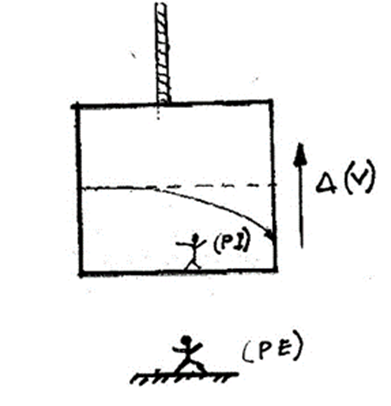
The text of the thought experiment described in the reference book talks about an elevator that “floats” in outer space. The elevator is pulled by a rope attached to its ceiling, which accelerates it. It says that there are two observers. One inside the elevator and one outside of it.

Its text is the following:

“Let's imagine that a horizontal ray of light enters the elevator through a side window, reaching the opposite wall after a very short time. Let's see how the path of light would be predicted by our observers."

The outside observer, who believes in the accelerated movement of the elevator, will argue: the light beam penetrates through the window, moving horizontally and in a straight line towards the opposite wall. But the elevator moves upward, changing position during the time the light lasts as it passes from one wall to the other. The ray will not illuminate, therefore, the point exactly opposite to that of its entrance, but rather a little lower. The difference, although very small, is real and consequently it turns out that the light moves with respect to the elevator on a curved line, like the figure we have drawn and not on the dotted line of the same figure.

The inner observer, who believes in the presence of a gravitational field acting on all the objects in his elevator, would say: the elevator has no such accelerated motion; A gravitational field simply acts inside it. A light beam that is imponderable will not be affected by gravity. If it propagates in a horizontal direction it will reach a point exactly opposite to that of its entrance.

It seems to emerge from this discussion that there is a possibility of deciding between both points of view, since the result would be different depending on whether one statement or the other was true. If there is nothing illogical in any of the reasoning that we have just presented, then all our previous argument falls to the ground, making it impossible, therefore, to consistently describe all the phenomena in question in two different ways: with or without a gravitational field.

But there is, fortunately, a serious error in the reasoning of the inner observer, which saves our conclusion. This said: “a light beam that is imponderable will not be affected by gravity. That's not true! A beam of light has energy and energy has mass. But all inert mass is attracted by a gravitational field since inert mass and gravitational mass are equivalent. A light beam will bend in a gravitational field exactly as would the trajectory of a body launched horizontally with a speed equal to that of light. Thus we see that, if the interior observer had reasoned correctly, taking into account the curvature of a light beam in a gravitational field, he would have arrived at the same result as the exterior observer.


3.- OUR ACCOUNT OF THE MENTAL EXPERIMENT THAT APPEARS IN THE MENTIONED BOOK.

To try to facilitate the understanding of the approach of the aforementioned mental experiment and at the same time declare an error that is committed in it, we have chosen to develop its content as if it were a story, giving it an argument.

We begin our story:

The thought experiment presents an elevator that ascends into outer space pulled by a rope. Ascends with accelerated speed:

Inside the elevator there is a person who we will identify as: PERSON INSIDE (PI).

Outside the elevator there is an observer who we will identify as: PERSON OUTSIDE (PE)

In our comments and opinions we will identify ourselves as: WE

We will identify the piece that belongs to the text of the experiment as NARRATOR.

A ray of light penetrates through the left wall of the elevator and ends its journey on the right wall.


The PE

He believes that the ascension of the elevator is what makes the curvature of light perceived.

US

We say that the (PE) is right in accepting the curvature of the ray of light.

But we contradict him, and say that he is NOT right in the cause he alleges. Later we will justify our opinion.

The (PI)

You don't realize that:

The rope is what moves the elevator. He attributes the fall of the masses (m) that are inside the elevator to the existence of a Gravitational field.

But he denies that the ray of light is curved due to Gravity and attributes it to a straight path.


STORYTELLER

The Narrator of the experiment says the following:

According to the above, there is a conflict between what they think (PE) and (PI).

The (PE) thinks that the ray of light bends.

The (PI) thinks that gravity cannot bend the path of a ray of light, although gravity acts on the masses (m) of the elevator.

US

In the end, the authors of the thought experiment to justify the validity of gravity exerting deflection on a ray of light, in their story, make the (PI) rectify their opinion. In their text they say the following:

“…But there is, fortunately, a serious error in the reasoning of the inner observer, which saves our conclusion. This said: “a light beam that is imponderable will not be affected by gravity.”

And now, putting an end to this “novel” they say the following:

“A beam of light has energy and energy has mass. But all inert mass is attracted by a gravitational field since inert mass and gravitational mass are equivalent. A light beam will bend in a gravitational field exactly as would the trajectory of a body launched horizontally with a speed equal to that of light. Thus we see that, if the interior observer had reasoned correctly, taking into account the curvature of a light beam in a gravitational field, he would have arrived at the same result as the exterior observer.

So “everyone is happy” and thus the deflection of a ray of light due to Gravity is justified. And nothing has been said about the “deformation of space”…


4.- AN ERROR IN APPROACH IN THE EXHIBITION OF THE MENTAL EXPERIMENT OF THE ELEVATOR

We have said that the (PE) affirms that the ray of light bends, but that it is not right with the reason it affirms for why it occurs. In the text of the book it is said that the (PE) believes that the ascension of the elevator is what makes it accepted that the curvature of light exists. This cause is NOT correct. It is a false opinion. All that was left was to mask this thought experiment with incorrect reasoning!…

We justify this error as follows:

If we consider a real case, in which we are the observer outside the elevator (PE) and as such the judges of the result of the observation, an error in approach is to consider that it is the ray of light that moves downwards. , when, on the contrary, it is the elevator that goes up. This seems to us to be a hoax by the authors of the aforementioned book to try to make their twisted arguments square, which later contradict each other by making Gravity intervene.

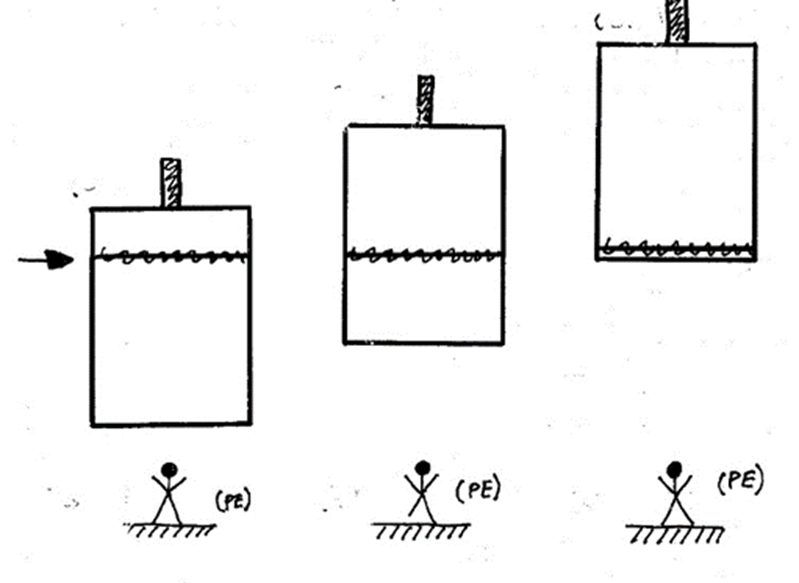
To graphically express our opinion, we have broken down the figure that we gave previously into three visions of the elevator's ascension.

The ray of light that enters from the left side of the elevator has been drawn. In the first view of the drawing, we place the entrance height of the beam at a higher level of the elevator. In the second vision the beam is approaching the middle part of the elevator, and in the third vision the beam is touching the floor.


Thus we visualize that it is not the ray that curves towards the floor of the elevator, but rather the elevator that goes up. Another issue is that the ray is curved by the action of Gravity.


domingo, 30 de julio de 2023

THE DEFORMATION OF SPACE - AN ERROR BY A. EINSTEIN

PRESENTATION

To the fallacy of “time dilation”, which we had already studied, A. Einstein needed to add another nonsense of logic to be able to create a “science fiction novel”. It is about “the deformation of space”. So it seemed that everything was adding up.

The bad thing is that he had disciples, and still has, who tried to support such a "novel." If there were no hidden interests, we are surprised that some scientific researchers committed such an outrage against science. We will comment on this in the paragraph entitled: "The fallacy of the false cause".

We take advantage of our essay to vindicate Newton's reasoning against Einstein's.

When we transcribe a text by other authors, we will write it in quotation marks and in italics.


THE THESIS OF A. EINSTEIN

About the "deformation of space" we have read the following:

“A. Einstein said, denying Newton, that gravity was not a force that attracted things, but that things do not move when they are attracted to something, but when they are pushed, and by this he meant that if something falls on something else, it is not because it is attracted to it, but because that thing curves space like a whirlpool in a bathtub. “

He continues the writing by saying the following:

“In Einstein's universe, continues the researcher, space and time are deformed by gravity. The Earth distorts the space around it ever so slightly because of its gravity.”

The following figure is the one we find in some treatises on this subject:


Note the reader that the historian from whom we have transcribed part of his writing, begins by saying: "A. Einstein said, denying Newton..."

We will try to validate Isaac Newton.


HOW DID THE RESEARCHERS THOUGHT TO PROVE EINSTEIN'S THESIS?

The researchers thought that the Sun, due to its Gravity, would curve space, in such a way that this phenomenon would become appreciable in the perception of the position of starlight.


(NOTE: On the historical fact of the experiments that were carried out to try to demonstrate the validity of A. Einstein's thesis, the reader can read it on the Web page, in the topic: "How the general theory of relativity was demonstrated". The image that we give is the one that appears in the aforementioned story).


DISADVANTAGES TO OBSERVE THE PHENOMENON

The story goes that the inconvenience to observe the phenomenon was that the light from the Sun would not allow us to see and portray the deflection of the light from the stars. They had to wait for eclipses of the Sun to occur and these occurred periodically in different places on Earth. Several expeditions were made according to the appearance of the eclipses.

A sketch of the distribution of the actors participating in the experiment could be the following:


THE FALLACY OF THE FALSE CAUSE.- AN IMPROPER

In the aforementioned expeditions, unless some historian rectifies us, we believe that an absurdity was committed:

Instead of going to find out the CAUSE they went to report an EFFECT.

And, with this error, they could contribute little to science. Even if the EFFECT was photographed, it contributed little to the validity of Einstein's thesis. For this reason we call such an experiment as "THE FALLACY OF THE FALSE CAUSE".


OTHER CRITICISMS OF THE REFERRED EXPERIMENT

In addition to not fulfilling the experiment with the required purpose, the dubious results obtained in his photographs were also criticized.

The famous physicist Stephan Hawking said the following: "The results obtained by Eddington were a matter of knowing in advance the results that one wanted to obtain."

They also accuse the expedition group "Prince" of manipulation. A reason for discussion is pointed out in a veiled manner, which tipped for success or failure, when the experiments were carried out just after the First World War and their possible resentments.


THE REFLECTION OF LIGHT, A PHENOMENON ALREADY KNOWN IN ANCIENT TIMES

A physical phenomenon that goes against the deformation of space as a cause for two masses to come together is the phenomenon of the deflection of light due to gravity. This phenomenon was already taken into consideration by Newton.

(NOTE: In a future study entitled: "The deflection of light. Interpretation of a confusing thought experiment", we will expand this topic).

Years ago, in one of our books we made the following drawing that represents the deformation of the deformed VISION of a body close to the attraction of gravity, due to the deformation of light. BEWARE! Do not associate it with the deformation of the mass as explained by A. Einstein in the chapter on the "measuring bar", criticized in another of our studies.


The figure represents a body referenced by the coordinates (X, Y, Z) in outer space. The vision (light) of this body is distorted by the presence of a gravitational field.


A CONTRADICTION TO THE DEFORMATION OF SPACE AS THE CAUSE OF THE APPROACH BETWEEN TWO MASSES

The following diagram represents the Earth and a mass on top of it. "stuck" to her.

Can we affirm that, because there is no space between them, it is possible to start off the ground and lift the mass without any effort? Is it not true that it costs more to lift a mass of ten kilos from the ground than a mass of one kilo, if the masses are "stuck" to the ground? And in this case space does not intervene.

Experience confirms that the deformation of space as the cause of the "fall" of one mass on top of another is a fallacy.


ANOTHER ARGUMENT TO DISCARD THE DEFORMATION OF SPACE

DIFFERENT MASSES AT EQUAL DISTANCE FROM THE ATTRACTIVE MASS.-

The following scheme represents two different masses (M1) and (M2 ) located with respect to the mass of the Earth (MT) at the same distance: (d1) = (d2)


In the next paragraph we will demonstrate that although the space, measured by the distances (d1) and (d2) is the same, the Attractive Force of (MT) to each mass is different.

Hence:

If two different masses, at the same distance from the attractive mass (MT), perceive different attractive forces from this attractive mass, we deduce that "space" does not intervene.


TWO DIFFERENT MASSES AT THE SAME DISTANCE FROM THE ATTRACTIVE MASS SUPPORT DIFFERENT FORCES OF ATTRACTION.

We will use the resources provided by Isaac Newton to show that two different masses at the same distance from the attracting mass support different forces of attraction.

Considering A. Einstein's nonsense that materialized space, deforming it and “selling it to us” in pieces, we have chosen to use more solvent tools to deal with the issue of the Force of Gravity. We will rely on the tools provided to us by the prestigious genius Isaac Newton. We believe that, at the same time, we vindicate Newton's position against Einstein.

We try to show that:

At equal distance to the attracting mass of two different masses, the forces of attraction to these masses are different

Let's remember Newton's formula of attraction of the masses

In which

(Fa) is the Force of Attraction exerted by an attractive mass (M) on another attracted mass (m)

(d)2 is the square of the distance between the two masses

(G) is the universal gravitational constant.

(NOTE: The validity of this formula has been verified and contrasted empirically. The value of the universal gravitation constant is also verified, among other experiments, with the Cavendish experiment, so we can certify the previous formula.

We also clarify a question that the reader might have. Remember that the acceleration acquired by the two masses in their free fall is the same. Precisely because the "mass" of each of them and the "force" to which the bodies are subjected intervene in this acceleration)

In the example that we have given in the previous paragraph, in which (d1) = (d2) and assuming two different masses (m1) and (m2), for these masses the Forces of Attraction will be:

(Fa)1 =  


and       

(Fa)2=


So if (M) is the same for the two attracted masses and also the value (d2) is common for the two masses:

Then, since (m1) is different from (m2), also (Fa)1 is different from

(Fa)2 which is what we have exposed in the previous paragraph.

We believe that in this way Newton wins the battle against Einstein.


A DOUBT: If we do not admit the deformation of space and if the concept "field of forces" is an abstract and intangible idea that does not describe the cause of the mutual attraction of two masses, perhaps the attraction of masses occurs between common microelements of the masses. Could it be the neutrinos?... We leave this subject for the investigation of the experts in this subject, it were not the case in which we would fall into fallacies and nonsense like the ones we are criticizing.

domingo, 11 de junio de 2023

THE RELATIVITY OF SIMULTANEITY. – A MISTAKE OF A EINSTEIN

PRESENTATION

In this essay we criticize the mental experiment exposed by A. Einstein in which he tries to relate an event that has the quality of SIMULTANEOUS, with RELATIVE movements.

The interest of this study is that the author of this experiment draws a crazy conclusion, which we ironically baptize as: "the miracle of transmutation"

We will take as a review guideline the book by A. Einstein entitled: "On the theory of special and general relativity" The transcriptions that we will make of this book will be written in quotation marks and in italics.


GRAPHIC INTERPRETATION OF THE MENTAL EXPERIMENT PROPOSED BY THE AUTHOR OF THE AFOREMENTIONED BOOK TO EXPLAIN THE RELATIVITY OF SIMULTANEITY

We transcribe the text of the mental experiment that appears in the book by A. Einstein.

For your best interpretation, we break down the transcription of the aforementioned experiment into pieces and, then, we will make its corresponding comment. Interested that the reader

Stay with the last two conclusions that we have transcribed from the aforementioned experiment.

The author of the book, using the well-known train car, begins by asking the following question:

"Two events, for example, two lightning strikes (A) and (B), which are simultaneous with respect to the embankment, are they also simultaneous with respect to the train?"

The following drawing shows three phases of advancement of the wagon. In it we make appear the two

LIGHTNINGS (A) and (B) and the RAYS OF LIGHT (A') and (B') that emerge from it.


 “…When we say that the rays (A) and (B) are simultaneous with respect to the tracks, we mean that the rays of light coming from the places (A) and (B) meet at the midpoint (M) of the track section (A)-(B). Now events (A) and (B) also correspond at places (A) and (B) on the train.”


In the drawing we have made the rays reach the ground and we have drawn a person at the midpoint (M´) of the distance between the rays


..." Now, the events (A) and (B) also correspond in places (A) and (B) on the train."

In the first stage of the drawing, the beam (A) passes just touching the rear of the wagon and the beam (B) just touching the front of the wagon.


…” Let (M´) be the midpoint of the segment (A)-(B) of the moving train. This point (M´) is true that at the instant of the lightning strike it coincides with the point (M), but, as indicated in the figure, it moves to the right with speed (v) of the train.”


At this midpoint (M´) we have painted a person fixed on the floor of the wagon and, as such, moves with him. This causes it to move toward the path of the light ray (B') and away from the light ray (A').


…” An observer who was sitting on the train at (M´), but who did not have this speed would remain constantly at (M) and the rays of light coming from the sparks (A´) and (B´) would reach him simultaneously , that is, these two rays of light would meet precisely in it.”


BEWARE! To make this paragraph more intelligible, instead of placing this observer inside the wagon but without speed, in the drawing we have painted him outside the wagon. He fixed on the ground. He would constantly remain at point (M), but we place him outside the wagon. The ray of light (A´) and of (B´) arrive SIMULTANEOUSLY to him

…”The reality is, however, that (judging the situation from the embankment this observer goes to meet the ray of light that comes from (B), fleeing instead from the one that advances from (A).


He refers to the observer who is inside the wagon, in (M´), and fixed in the center of it.


…” Consequently, you will see the light coming from (B) before the light coming from (A). In short, the observers who use the train as a reference body have to conclude that the electric spark (B) has fallen before the (A).”


  The observer that we have placed outside the wagon, as we have indicated in the previous section, says that this observer sees that the person who is inside the wagon reaches the ray of light from (A) before the one from ( B).

…” In short, observers who use the train as a reference body have to conclude that the electric spark (B) has fallen before (A).

We thus arrive at an important result.

Events that are simultaneous with respect to the embankment, are not with respect to the train, and vice versa (relativity of simultaneity).”

Here the narration of the aforementioned experiment ends.

We will criticize this conclusion, which goes against the First Principle of Relativity.


FIRST PRINCIPLE OF RELATIVITY

In the book that we take as a reference, he considers a Fixed Reference System (SRF) and a Moving Reference System (SRM) and announces as the First Principle of Relativity:

  "If a (SRM) moves with respect to a (SRF) then natural phenomena occur with respect to the (SRM) according to the same general laws as with respect to the (SRF)"

This Principle was already announced by Galileo. Summing up, his explanation, he mentions a ship that advances at a constant and rectilinear speed. He says that in his winery natural phenomena, for example, the flight of a fly, the fall of water from an upside-down bottle... occur in the same way that they occur on the coast.


SIMULTANEOUS EVENTS OCCURRING OUTSIDE A MOBILE REFERENCE SYSTEM.- CRITICAL

If a simultaneous event occurs outside of a Mobile Reference System (SRM), it is absurd to want to apply the theory of relative motions to it. This is what happens in the mental experiment proposed by A. Einstein. This "relativity of simultaneity" goes against precisely the First Principle of Relativity that we have commented on in the previous paragraph.

  In the conclusion of the aforementioned experiment we have transcribed that it says:

“We thus reached an important result.

Events that are simultaneous with respect to the embankment, are not with respect to the train, and vice versa (relativity of simultaneity).”


  This can be interpreted as what happens in the Fixed Reference System (RRF) does not happen in the Mobile Reference System (SRM), which is the first step to doubt the validity of such a mental experiment.


A second step that corroborates that the mentioned mental experiment is a fallacy, is the following:

We know that a fallacy occurs when a logical syllogism is to be taken for true and one of its premises is false.

In the aforementioned thought experiment we put forward the following syllogism:

1st PREMISE    The First Principle of Relativity considers the

                          performance of natural phenomena


2nd PREMISE    Simultaneity is a natural phenomenon


CONCLUSION     SIMULTANEITY considers the performance of

                             natural phenomena

The second premise is false. Simultaneity is not a natural phenomenon. It is a quality that the event of an event has. Grammatically it is a qualifying adjective. It is not a verb. Consequently, the above syllogism is a fallacy.


THOUGHT EXPERIMENTS WHERE SIMULTANEITY OCCURS WITHIN THE MOBILE REFERENCE SYSTEM (SRM)

If the simultaneity of an event occurs within a Mobile Reference System (SRM), it is logical that we can apply the theory of relative movements. The event occurs "inside Galileo's ship" of which we had spoken.

We have devised a mental experiment, with relative movements between the train car and a fixed observer outside the car, and where the SIMULTANEITY event occurs inside the car. In this case, we could talk about the relativity of movements.

The following drawing represents three phases of advance of a wagon that goes at a rectilinear and constant speed.

In the center of the wagon there is a person who holds a mass in each of his hands. The masses have equal weight.

Outside the wagon there is a fixed observer on the ground


Due to the displacement of the wagon, at the moment that the person who is inside passes in front of the observer who is on the ground, that person who is inside releases the two masses at the same time. We consider this as a SIMULTANEOUS event.

We observe that in the intermediate step of the drawing it is seen that the masses have not yet touched the floor of the wagon.

In the last stage that represents the drawing, the masses have already arrived on the ground.

The observer who is fixed on the ground (SRF), will see the different phases in which the masses fall, in the different phases of the wagon's advance.

We can observe that the physical phenomenon of the masses falling to the floor of the wagon is exactly the same as what would happen to the person outside the wagon (SRF). Therefore, the First Principle of Relativity is fulfilled.


THE NONNESS OF A. EINSTEIN

The author of the aforementioned mental experiment intends to establish a correspondence between what an observer sees, who considers it as a Fixed Reference System (SRF), and what an observer located inside the wagon sees. But, be careful, the gazapo is that natural phenomena do not occur inside the wagon. We cannot consider that an Inertial Reference System has been established.

Not realizing this error, he preaches the following:

"The time that a process needs with respect to the wagon cannot be equaled to the duration of the same process judged from the reference body of the embankment"

This is where we say that his statement amounts to the "miracle of transmutation"

Now he seems to forget the First Principle of Relativity that he cited and that we have written in the second paragraph. He now speaks of "a process" and not of the laws that govern natural phenomena. The confusion he commits on the subject of "relativity of simultaneity" makes him interpret the vision from the (SRF) of the events that occurred in the (SRM) in a different way.