jueves, 22 de septiembre de 2022

THEORY OF SPECIAL RELATIVITY - THE PARADOX OF A TRANSMUTATION

PRESENTATION

To help interpret and understand the metaphorical meaning given to the title of this essay, we transcribe the following definition and explanation: "PARADOX: Fact or saying contrary to logic." “TRANSMUTATION: It implies the change of the atomic nuclei. Change one element into another. We believe that in the course of this study we will be able to clarify the metaphorical meaning of the aforementioned title. In order to criticize the aforementioned theory, we have highlighted a paradox that we have called the paradox of transmutation.


1. ARGUMENT THAT FOLLOWS THIS ESSAY.

In order to justify that the postulates cited by A. Einstein and that with them he builds his theory are a paradox, we will take as a guideline for follow-up his book entitled: "On the theory of special and general relativity" (Ediciones Altaya S.A. February 1999) The affirmations and postulates that appear in the book are transcribed between quotation marks and italics.

Interpreting the meaning and the order in which its paragraphs are written, we have realized that it leads us to the aforementioned paradox. This being so, this is the path that we will follow in the study of this essay. We believe that our essay is an investigation about what he thought and came up to Einstein when he made his Theory. We will expose these ideas in the same order in which the paragraphs of it are written. And, on these, we will make the pertinent comments that, as we will see, lead us to the acceptance of the title of this essay.

Next, we write the titles that appear in our essay and, in abbreviated form, we summarize the ideas that we get from the paragraphs of the aforementioned reference book:

  PRINCIPLE OF RELATIVITY. It establishes an identity of results between a Fixed Reference System (SRF) and a Mobile Reference System (SRM). The idea is that the events PASS in the same way

THEOREM OF THE ADDITION OF VELOCITIES. It proposes two ways of assessing the same event viewed from two different Reference Systems. THEY SEE WITH DIFFERENT VALUES

INCLUSION OF THE SPEED OF LIGHT. It includes the light in the postulates of it. We identify it with the verb SEE. Expresses the intention of being able to SEE from a Reference System what happens in another

LOOKING FOR A COMPROMISE SOLUTION. It fits the constant speed of light with the Velocity Addition Theorem. You need time and space to be "elastic." Use the “trick” of the space-time idea

  THE RELATIVITY OF SIMULTANEITY. The genesis of the paradox. An ill-conceived thought experiment.

A THESIS.- Explanation of the path of how we have arrived at the concept: Paradox of a Transmutation

Next, we develop the previous concepts.


2.- THE PRINCIPLE OF RELATIVITY

As we have said in the “Argument that follows our study”:

It establishes an identity of results between a Fixed Reference System (FRS) and a Mobile Reference System (MRS). The idea is that the events PASS in the same way

In the book by A. Einstein that we take as a study reference, he gives as an example the mental experiment of the train car, which we have already talked about in other of our essays. Starting the reading of this book the first postulate that we find is the following:

 “If a (MRS) moves with respect to a (FRS) then the natural phenomena occur with respect to the (MRS) according to the same general laws as with respect to the (FRS).”


(NOTE: A Fixed Reference System is abbreviated as (FRS) and a Mobile Reference System is abbreviated as (MRS))

We accept that it is true that "natural phenomena PASS according to identical laws", but, as we read the following paragraphs, it seems to us that the Physicist's intention is not only to indicate that "they pass" but that he has the intention of wanting say that they can be SEEN and MEASURED. Corroborates our affirmation, the one that in the following paragraphs dedicates them to the speed of light (c) and to how the speed of a body launched from inside a moving mobile is SEEN and calculated from the ground. We talk about this topic in our next paragraph.


 2.- THEOREM OF THE ADDITION OF VELOCITIES

As we have said in the “Argument that follows our study”:

It proposes two ways of assessing the same event viewed from two different Reference Systems. THEY SEE WITH DIFFERENT VALUES

In paragraph 6 of the aforementioned book it appears as a title; “The velocity addition theorem according to classical mechanics”. We will consider this paragraph as the beginning of the RERELATION between the (SRF) and (SRM), in order to expose the fallacies of the special theory of relativity.

HE Give as an example:

A train runs at a speed (vt).  Inside it a person walks at a speed (vp). The total speed (vT) with which an observer outside the train will appreciate that the person inside the car moves will be:


                                      (vT) = (vt) + (vp)

That is, the two speeds are added. This (VT) is the speed that the man moves with respect to the track.

We think that by saying that "I WILL APPRECIATE", this verb includes the intention to SEE and then CALCULATE.

(NOTE: We highlight the verb SEE since at the end of this essay we will use this verb to demonstrate a contradiction between the postulates preached by A. Einstein)

The same statement of the Velocity Addition Theorem can also be explained as follows:

 inside the wagon a person throws a stone, and it is a question of calculating at what speed the VE circulates an observer who is outside the train wagon.

This version, which we give now, may help us more in the following explanations that we will present.

We insist that the inclusion of this Theorem in his book is the first step in wanting to relate the (SRM) with the / SRF)


3.- INCLUSION OF THE SPEED (c) OF LIGHT

As we have said in the “Argument that follows our study”:

It includes the light in the postulates of it. We identify it with the verb SEE. Expresses the idea or intention of being able to SEE from a Reference System what happens in another

If the first step was wanting to RELATE the (SRM) with the (SRF), we detected a second step by trying to include light in its postulates. It is intended to include the speed of light (c).

In the aforementioned book, he comments on the impossibility of including the speed of light (c) within the variables that make up the Velocity Addition Theorem. At that time, it had already been verified that this speed is constant. Unlike the stone that is thrown from inside the wagon, the speed of light does not depend on where the electromagnetic wave is “mounted”.

But he makes a comment that he intends to relate: the VIEW of an (FRS) of what happens in an (MRS), as he has described in the Velocity Addition Theorem:

“… Later we will see that this reasoning, which expresses the theorem of the addition of velocities according to classical mechanics, is untenable and that the law that we have just written is not valid in reality. But in the meantime we will build on its validity.”

This is where we say that an intention to SEE manifests. We repeat what we have already said: "it seems to us that the intention of the Physicist is not only to indicate that they "elapse" but that it has the intention of wanting to say that they can be SEEN and MEASURED".

SEE, when wanting to make light intervene and MEASURE when starting from the Speed ​​Addition Theorem.

(Note: Perhaps in the present times it seems obvious to us that we cannot make variables that represent a mass and those that represent an electromagnetic wave intervene in the same equation. Another thing that we can do is use the mathematical operator that can relate us the speed (v) of a mobile with the speed (c) of light in the same equation. This operator is known: Lorentz factor)

4.- LOOKING FOR A COMPROMISE SOLUTION

As we have said in the “Argument that follows our study”:

It fits the constant speed of light with the Velocity Addition Theorem. You need time and space to be “elastic”

If as announced in the First Law of Relativity:

“…natural phenomena occur with respect to the (MRS) according to the same general laws as with respect to the (FRS).”

and, according to what we have commented in the previous number, when SEEING THEM and MEASURE THEM, according to this postulate we must obtain the same results, the Physicist has a problem. To relate to each other and be able to SEE from an (FRS) exactly the same events that occur in an (MRS), if the speed of light is constant (it is not a function of the speed of the (MRS)), to adjust this vision gap requires that time and space are not fixed but "elastic" so that both the passenger and the observer SEE and VALUE the natural phenomenon in the same way. And, it seems, that then the following idea arises: The time of VISION, becomes relative like space and makes "the invention" of space-time. This is how you adjust what doesn't fit. Observe the reader that we have pointed out the verb “TO SEE”. We are in the first step in which, by making the speed of light (c) intervene, everything revolves around using the verb VISUALIZE.

(NOTE: In order not to mix concepts, we warn the reader of the following. Another different aspect is that, as we are dealing with relative movements and we are talking about the occurrence of Events, to position them we must give their SITUATION (in space) and their  moment(time) it happe. in which it is happening), that is, the instant in which this SITUATION occurs.)


5.- THE RELATIVITY OF SIMULTANEITY

The title of this issue corresponds to paragraph 9 of the aforementioned book. This is where the nonsense begins that we have called "the paradox of transmutation

On page 27 of the aforementioned book, he asks the following question:

“…Two events (for example, the two lightning strikes A and B) that are simultaneous with respect to the embankment, are they also simultaneous with respect to the train?... We will soon show that the answer must be negative...

We transcribe the drawing that appears in the aforementioned book to answer this question.

Figure 1


The explanation that Einstein writes in his book is transcribed at the end of this paragraph. We, sticking to exactly what the book says, to make it more intelligible to the reader, we explain it graphically using the following drawing.

                                                       Figure 2

 
This figure represents the railcar in motion (SRM). An observer sits in the center of the car. Three forward positions are successively represented, at a speed (v). Two rays are fired at the same time from (A) and (B), just touching the opposite walls of the wagon and when it occupies the first position in the drawing. These rays, which are represented by short arrows, are not perceived simultaneously by the observer located in the center of the wagon. Why, due to the movement of the car to the right, at speed (v), the observer will not perceive the existence of the two rays at the same time. The beam coming from (A) will take longer to reach the observer's crosshairs, since the observer is moving along with the wagon in the direction of moving away from the starting point (A). Regarding the ray that has started from situation (B), the opposite occurs than the one that comes from (A). The observer will have been approaching the situation (B) shortening the duration of the arrival of the aforementioned ray. Observing the aforementioned arrows, this is what the second and third position of the previous drawing intend to expose.

In the lower part of the drawing an observer has been represented who is on the ground and who remains immobile in the same starting situation as the observer who, on top of the wagon, occupied the central part of it. Rays (A) and (B) reach this stationary observer (FRS) simultaneously.

From here A. Einstein deduces that the SIMULTANEITY of two events must be valued differently from a (MRS) to a (FRS).

And his response appears on page 28 saying:

“…Events that are simultaneous with respect to the embankment are not so with respect to the train, and vice versa (relativity of simultaneity). Each reference body (coordinate system) has its special time. A temporary location only makes sense when the body of reference to which it refers is indicated…”

and then in the same paragraph he writes:

“The time that a process needs with respect to the wagon cannot be equal to the duration of the same process judged from the reference body of the embankment”

It is in this statement that we state the Paradox of Transmutation.

We believe that Einstein's reasoning is not correct.

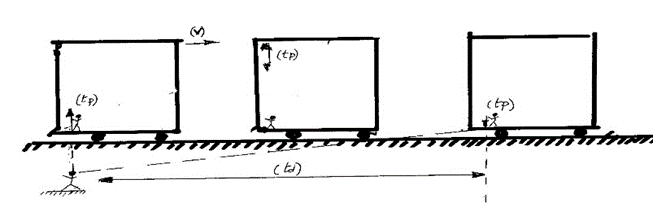
We are looking at events that have a Proper Time (tp) inherent to them. Let us remember that we already said this in the thought experiment in which the event was “the reflection of a ray of light in a mirror”. Now the event is "a simultaneous occurrence" We think that this "simultaneous occurrence" is the event and we must design it in a different way from how the aforementioned Physicist poses it. The following drawing is intended to illustrate our reasoning.

                                          Figure 3


In the figure we want to express that now the roles have been changed regarding the evaluation of Proper Time (tp) that we made in the phenomenon of the reflection of the light ray. Now the observer who quantifies the Proper Time (tp) of the simultaneous perception is the one outside the car. He fixed on the ground. That is, the (FRS). The event: "a simultaneous occurrence" has its (tp) that reaches the (FRS) from both sides.

It is evident that its value would be the same on both sides and would depend on its distance (FRS) from the train car'.


A COMPARISON WITH THE THOUGHT EXPERIMENT OF THE REFLECTION OF THE RAY OF LIGHT IN THE MIRROR

  We can establish a comparison of the current case with that of the mental experiment of the event "reflection of the light ray in the mirror" that we commented on in some of our previous essays. Figure 4 4 serves to illustrate this case.

                                       Figure 4


The person that A. Einstein places inside the wagon, in the light ray reflection experiment, was the operator who carried out the experiment and measured his Proper Time (tp). The person who was on the embankment (FRS) is the one who perceives the effects of the movement of the wagon.

On the contrary, in the example in which the object of observation is "a simultaneous event" the person who observes the (tp) becomes the person outside the car (FRS). while it is the person inside the wagon (MRS) who observes the changes that occur due to the displacement of the wagon. Nothing to invent different perceptions of a simultaneous occurrence! There is a Proper Time (tp) of the simultaneous event, and only one, no matter how much the author of the book wants to fit the events so that they adapt to his Theory. This is what leads to nonsense.

Let us remember that he had already used the space-time trick to avoid "compromise situations".

As we announced at the beginning of this paragraph, we transcribe the explanation that A. Einstein makes regarding the relativity of simultaneity:

When we say that the rays A and B are simultaneous to the tracks, we mean: the rays of light that leave places A and B meet at the midpoint M of the section of track A-B. Now events A and B also correspond to places A and B on the train. Let M´ be the midpoint of the segment A-B of the moving train. It is true that this point M' coincides with point M at the instant of the lightning strike, but, as indicated in the figure, it moves to the right with the speed (v) of the train. An observer sitting on the train at M', but not having this speed, would remain constantly at M, and the light rays from sparks A and B would reach him simultaneously, that is, these two light rays they would gather precisely in it. The reality is, however, that (judging the situation from the embankment) this observer goes to meet the ray of light that comes from B, instead fleeing the one that advances from A, therefore, he will see the light that comes from B first. than the one that comes out of A. In short, the observers who use the train as a reference body have to reach the conclusion that the electric spark B has fallen before the A. We thus arrive at an important result: Events that are simultaneous with respect to the embankment are not simultaneous with respect to the train, and vice versa (relativity of simultaneity).”


6.- A THESIS

Analyzing the content and the order in which the paragraphs of the book that we have taken as a study guideline are written, we believe that we have been able to find out the idea, the intention and the mistake made by A. Einstein when considering the theory of special relativity.

Our thesis based on everything we have discussed in the previous issue is as follows:

It seems that A. Einstein, with the idea of ​​investigating the Relativity of Simultaneity, wants to be able to affirm that, when an event that occurs within a (MRS), this same event can be SEEN SIMULTANEOUSLY from its corresponding (FRS). So there is no doubt that the event is IDENTIFIED.

To make such an identification, he tests using a thought experiment whose approach is wrong.

And, with this erroneous approach, he makes his thesis. He says that an event that occurs within an (MRS) can NOT be seen simultaneously from its corresponding (FRS)

And, with this erroneous thesis, he is forced to not be able to IDENTIFY from an (FRS) an event produced in an (MRS).

And, here is born the nonsense or the Paradox of Transmutation. We repeat his statement:

“The time that a process needs with respect to the wagon cannot be equal to the duration of the same process judged from the reference body of the embankment”

Regarding the content that we have commented on the previous paragraphs of the aforementioned book, we can appreciate that now he seems to forget the Principle of Relativity that he cited and that we have written in the second paragraph. Now he speaks of "a process" and not of the laws that govern natural phenomena. Perhaps the confusion that he commits on the subject of "relativity of simultaneity" makes him interpret in a different way the vision from the (FRS) of the events that occurred in the (MRS).

  Note the reader that the nonsense comes from having considered the "Relativity of Simultaneity" as two events, and not just one with its corresponding Proper Time.

Here the author of such a statement, using his error as a postulate, no longer tries to SEE in a different way from the (FRS) what happens in the (MRS), but affirms that they OCCUR in a different way when they are located in the ( FRS). This is where the nonsense is generated. The meaning of the given statement makes us think of the verb BEING in a different way, and not of SEEing in a different way. We could only accept it if a TRANSMUTATION takes place... which is a PARADOX. Nonsense!

miércoles, 6 de julio de 2022

THEORY OF RELATIVITY - ANALYSIS OF A PARADOX

PRESENTATION

Some treatises on the Theory of Relativity explain the story of the “Twin Brothers” saying the following: “In two twin brothers, one of them is an astronaut. The astronaut leaves for a sidereal flight in which he reaches a speed close to that of light. Returning to Earth he finds that his twin brother has aged much older than he has.

The following figure tries to represent this circunstance:

                                         Figure 1


The drawing represents the beginning of the journey, the journey, and the return. In this third phase, the older brother who has remained on Earth is represented. In the aforementioned books this nonsense is called "the paradox of the twin brothers"

Looking for the definition of paradox, we have found as a definition: "Done or said apparently contrary to logic." It is curious that, considering the meaning of this word, they still dare to maintain science fiction arguments that seek to validate such a paradox, thus protecting the false theory of time dilation. Next, we explain the reason for such an outrage to logic.


GENESIS OF FOOLISHNESS

In A. Einstein's book entitled: "On the Theory of Special and General Relativity", he quotes a train car that runs with uniform speed and rectilinear, and then makes the following statement:

“The time that a process needs in relation to the wagon cannot be equal to the duration of the same process judged from the reference body of the embankment”

This statement generates the fallacy of time dilation and the other nonsense that we see written about the Theory of Relativity.

In this statement we find three errors:

A logical error in the statement that appears in the aforementioned book

A contradiction between two statements that appear in his own cited book

An erroneous interpretation in different treatises on the subject of the aforementioned theory, to try to validate nonsense.


We briefly describe these errors below.


AN ERROR OF LOGIC:

In the quoted statement he uses the word PROCESS.

We understand and define as a process:

"The occurrence of two or more Events linked to each other and keeping a certain sequence in their realization and that requires a certain execution time"

When mentioning in the aforementioned statement "the time that a process requires", this time is INHERENT to the process. It will serve to identify it and we will call it Own Time of the Process (tp). And you can't have another when looking at it from outside the train car. Or from different situations in outer space.

Two different Proper Times imply two different Processes

A PROCESS is not transformed by the mere fact of contemplating it from outside the car

A CONTRADICTION BETWEEN TWO STATEMENTS THAT APPEAR IN THE CITED BOOK

In the statement that we have transcribed from the aforementioned book, "the time that a process needs in relation to the wagon, no...," a contradiction appears.

This affirmation has been tried to express it in some books by means of the following drawing:

                                            Figure 2


In this drawing appears one of the PROCESSES, of which the referred affirmation speaks. It is the one followed by a beam of light emitted inside the car. This ray is reflected in a mirror located on the roof of it. From this they deduce that the time that the beam takes to go to the mirror, reflect in it and return to the starting point where the person who fired it will be different for this person from the one who is fixed on the embankment of the train.

But… in another part of the book it says:

“If a (SRM) moves with respect to a (SRF) then the natural phenomena occur with respect to the (SRM) according to the same general laws as with respect to the (SRF).”

What are we left with?... This statement is against the other statement that says:

"The time that a process needs in relation to the wagon, no...".

If we consider the person who is fixed on the ground of the embankment as the Fixed Reference System (SRF) and the PROCESS is developed in the environment of a Mobile Reference System (SRM)… “then the natural phenomena take place with respect to the (SRM ) according to the same general laws as with respect to the (SRF).”

And therefore, the observer outside the wagon should not experience any difference to the phenomenon that occurs inside the wagon. This is the contradiction that we announced.


A WRONG INTERPRETATION TO TRY TO VALIDATE A FOOLISHNESS.

 To improve the interpretation of what we want to explain, we propose to use another drawing. Like the previous drawing, Figure 3 means the movement of the train car inside which a beam of light is shot that is reflected in a mirror located on the roof of the car.

                                               Figure 3


The round trip time of the light ray is its Proper Time (tp) In each advance position of the wagon the direction of the ray is represented. With this drawing we may clearly see that the ray of light is moving in the same vertical as the person who launches it and that it has its Own Time (tp) inherent to this phenomenon.

It is absurd to argue that, as the person who is outside the car, fixed on the ground, has lengthened the completion of the reflection of the ray of Light, time has dilated.

From outside the wagon: The VISION of the image of the phenomenon is lengthened. Not the Proper Time (tp) of the phenomenon

Applying this conclusion to the “twin brothers paradox” we can say:

If we assume that the person who launches the lightning from inside the train car is the astronaut twin brother, we can affirm that both the Reflection Process of the lightning and the biological process of the aforementioned person have their Proper Time (tp) invariable compared to observation from Eart

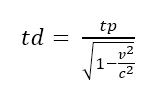
(NOTE: in the treatises on the subject that concerns us, they present a relationship between the Travel Time of the ray (td) and the Proper Time (tp) of the reflection phenomenon. This relationship is as follows:

                          
In which the expression: 1/√(1-v^2/c^2 ) is known as the "Lorentz Factor", and in which (c) is the speed of light. (The calculation of this relationship the reader can find described in one of our essays)

As the aforementioned books state that the (td) is the time it takes for the man located outside the train car to see the end of the ray reflection process and , the (tp) is the Proper Time, which is the one that sees the man who is inside the wagon and, as the Lorentz Factor has a value greater than one, they come to the strange conclusion that time dilates since: (td) > (tp).

we repeat that from outside the wagon WE SEE the lengthening of the end of the phenomenon due to the displacement of the wagon. This elongation is due to the Travel Time (td))

A THIRD LOOK

Unlike physical experiments, so-called thought experiments sometimes stray too far from reality and logical reasoning in their approach. We could apply this statement to the mental experiment of the train car that we have previously exposed, and another experiment that A. Einstein uses in his aforementioned book. It is about the mental experiment that he proposes so that we accept as valid the “Principle of Equivalence”. It is another fallacy that we have already talked about in other of our essays. With the sole purpose of stopping to make a brief reflection on this topic, we have tried to visualize with a drawing what happens in these thought experiments. We have baptized such a drawing as "the third eye"

                                                      Figure 4

          
This drawing is intended to suggest the following. It is we who are judging what could happen in the Thought Experiment that poses the fallacy of time dilation and, by assimilation, the paradox of the twin brothers.

It is our eye that visualizes and analyzes the situation. It is an observation outside the gaze and interpretation of the two acting agents. In other words, the man who is riding the train and the man who is still on the embankment and contemplates the course of the ray of light. Our eye, the Third eye, will see that the man standing still on the ground SEES that the Process is lengthening for the astronaut. He sees that the Process is slowing down. But we reason that life is not slower for the astronaut, but rather that he is mounted on a vehicle that transports physical phenomena: the phenomenon of the reflection of a ray of light or the biological phenomenon of the person who launches the ray. And this does not modify at all the Proper Time (tp) of the Processes of it.


THE TIME DIFFERENCE BETWEEN MOBILE CLOCKS

In this paragraph we denounce the fallacy of the mobile watch test. This fallacy is intended to justify the nonsense of "time dilation."

Its promoters say that a mobile clock with respect to another fixed one, and moving this mobile clock at a speed close to that of light, the time indicated by this clock dilates. They are talking about infinitesimal and almost negligible units. These advertisers of such a fallacy justify this time difference by speaking of an experiment of doubtful authenticity and verification, carried out with atomic clocks, without any guarantee of authenticity. We criticize this argument again using the logic

The following figure represents the train car that we mentioned before, but that now we do not consider the launch of a ray of light. Inside it now contains a pendulum clock.

                                  Figure 5

       
The person who is fixed on the ground has a clock that controls the passage of time. This fixed clock will be taken as a time reference.

The pendulum clock swings from left to right and vice versa. We ask ourselves: can we say that the time inside the wagon has been dilated because the fixed observer takes a longer time to SEE the oscillation that the pendulum makes from left to right? oscillation is due to the fact that the fixed observer's vision of the arrival goal is being displaced. None of the “time dilation” nonsense!

The doubt might arise that we have exposed this thought experiment in which we have implicitly assumed that the pendulum could swing thanks to gravity. The reader will already understand that we can do this same approach in outer space, using a mechanical watch.

 We believe that with the above reasoning we have declared the “twin brothers paradox” to be a fallacy.


lunes, 4 de abril de 2022

THE FALLACY OF THE DEFORMATION OF SPACE AND MASS AND THE LORENTZ FACTOR

PRESENTATION

Through our Blog, we have criticized the nonsense of involving the deformation of space to justify the force of attraction of gravity on bodies.

 As we have recently seen false information appear that attempts to confuse logical reasoning regarding this issue, we add a new essay to dismantle such fallacy.

Some of these false news, pretend to rely on the idea that: the Physicist who affirmed such a fallacy, is the same one who predicted the existence of gravitational waves, whose existence has subsequently been verified. It seems that these false preachers justify the fact that we must admit the nonsense of the deformation of space since it was said by the same person who was right with the phenomenon of gravitational waves. We think that, if there are no hidden interests, those who reason in this puerile way commit a fallacy of the type "argumentum ad homine"

Our criticism will be based on highlighting a false interpretation of the Lorentz Factor and the Lorentz Transformation Formulas that lead to the aforementioned error.


TWO MENTAL EXPERIMENTS THAT DENOUNCE THE FALLACY OF THE DEFORMATION OF SPACE.

In this essay we include two thought experiments,

that were devised by the same author of the present study.

We believe that the two examples are sufficiently illustrative to refute the fallacy of the intervention of the deformation of space as an active agent in the intervention of the force of gravity. (We exposed these examples in our Blog, with the title: "Theory of Relativity. - Misleading Approaches"- Third instalment- The fallacy of the deformation of space)

We comment and summarize the cited examples.

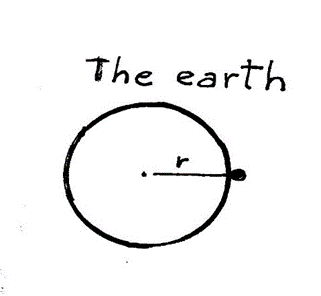
 The first figure represents a Test Mass (for example, a stone) that, because it is "touching" the Earth and there is no space between both masses... can we say that there is no attractive force, such as gravity, when not be able to deform space?... This shows that it is not the intervention of the deformation of space that acts.

                                     Figure 1


Figure 2 presents the case of two different masses (m1) and (m2) that are at the same distance from the bringing Mass, that is: (d1) = (d2). Carrying out calculations it is found that, although the space between the attractive mass (Mt) and the two test masses (m1) and (m2) is the same, the Attractive Force is different. What justifies that "space" does not intervene

                                       Figure 2


(ONE OBSERVATION: Do not confuse concepts: It is interesting that we bear in mind that the ACCELERATION with which both Masses are subjected is the same, but they are subjected to different Forces of Attraction (Fa). We must consider that what we are investigating is the concept "FORCE" and not the concept "ACCELERATION". We investigate the cause. Not the effects. For this reason, it is interesting to take into account this conclusion that could divert us from our objective)


THE LORENTZ FACTOR

It is known as the Lorentz Factor and is usually represented abbreviated as (L), the mathematical operator:

                             
Where (v) means the speed of a moving body, with uniform and rectilinear speed, and (c) means the speed of light.

We find this expression in the well-known thought experiment of the train car. It is obtained by looking for the relationship between the Proper Time (tp) of the physical phenomenon that takes place inside the wagon (the reflection of a light ray in a mirror), and the Time of Displacement of the train wagon (td). This relationship is quantified by the following expression:


(Note: In other essays by this same author, the mathematical process to obtain this expression is detailed)

 In the erroneous interpretation given to this equality, the fallacy of "time dilation" and "mass and space deformation" starts. We justify our statement by recalling some paragraphs written in our previous essays.

In one of them we call it the GENESIS OF NONSENSE

We say that your misinterpretation comes from the statement that we find in the book by A. Einstein, entitled: “On the theory of special and general relativity”. Speaking of a train car inside which a process is carried out, in this statement he says:

“The time that a process needs in relation to the wagon cannot be equal to the duration of the same process judged from the reference body of the embankment”

In our "little book" entitled: "Theory of relativity. - Criticism of nonsense”, we present more than three reasons to justify that this statement cannot be accepted as valid.

Figure 3 means the movement of the train car inside which a beam of light is fired that is reflected in a mirror located on the roof of the car. The round trip time of the light ray is its Proper Time (tp). In each advance position of the wagon, the direction of the beam is represented.

                                      Figure 3


this absurd to argue that, since the person who is outside the car, fixed on the ground, the end of the reflection of the light beam has been lengthened. Light, time has dilated.

From outside the wagon: The vision of the image of the phenomenon is lengthened. Not the proper time (tp) of the phenomenon


THE FALLACY OF THE DILATATION OF THE MASS

In this chapter we denounce another fallacy that can lead us to the error of reasoning that "space is deformed" since, if we consider that mass occupies a place in space, considering absurdities, we can conclude that the space it occupies is deformed. To criticize this issue, we transcribe a part of our book entitled “Theory of Relativity. Criticism of nonsense analysed in seven fascicles”

We copy the following fascicle:

 In this Fascicle, taking as a reference the book of

A. Einstein entitled "Introduction to the theory of special and general relativity", we denounce:

The fallacy of mass deformation. The error of wanting to include simultaneous phenomena within relativity and… other confusion We criticize the subject: “THE LENGTHENING OF THE MEASURING BAR.

Paragraph 12 of the aforementioned book that we take as a reference is entitled: "THE BEHAVIOR OF RULES AND MOBILE CLOCKS" It is based on the mental experiment of the train car and, summarizing its content, it tells us that: using a bar to measure lengths, this bar will be longer assessed from the embankment, than assessed from inside the train car. We clarify that instead of saying "WILL BE" longer we should say: "WE WILL SEE" longer.

We could call it as: The great confusion between the appreciation of the dimensions of the IMAGE OF A BODY in uniform and rectilinear movement and the real dimension of this BODY. In the lengthening of the measuring bar, he confuses the movement of the image of the body as if it were the body itself

                                  Figure 4


The measuring bar has its own length (lp) which is what

 would get an observer who was inside the car, where the bar is. Another experiment would be the result of the SEEING, or the VISION OF THE IMAGE, of a fixed observer located outside the train car.

We have seen written the project of trying to deduce the well-known expression:  

in which in an intermediate step of the mathematical process a factor is added to take into account the "dilation of the mass" and, at the end of the process, this factor is removed or annulled without giving a coherent explanation. The mental confusion to which the Theory leads is such that it seems that one cannot reason without it, although in the end one must end up removing what is in the way”

(End of the cited transcript)


(NOTE: See the same author of this book, the Essay published by the scientific journal: "International Journal of Fundamental Physics Sciences", called the expression

informs us that in ancient times there was a great explosion that expelled the atoms from a common environment”)


THE FORMULAS OF TRANSFORMATION OF LORENZ

The Lorentz factor is also found in the so-called Lorentz Transformation Formulas.

These formulas, in inertial movements (relative movements between two reference systems and at constant rectilinear speed) allow to calculate the values ​​of the variables: space (e) and time (t) in a MOVING translation of the coordinates.

(Later we will see why we highlight the word “mobile”)

To introduce us to the topic of Lorentz Transformation formulas, we quote the following.

In the book “On the theory of special and general relativity” by A. Einstein, on page 32 (“Alianza Editorial” Edition), he describes the form and utility of the formulas called Lorentz Transformations, as follows:


“Given the quantities (x,y,z,t) of an event with respect to (k),

What are the values ​​(x`,y`,z´,t´) of the same event with respect to

(k´)?”

The ratios must be chosen in such a way that they satisfy the laws of propagation of light in a vacuum for one and the same light ray (and also for any light ray) with respect to (K) and (K´).”


And he goes on to say:

"The problem is solved by the equations"


                    Space Formula

                      Figure 1

 
                    time formula

                     Figure 2

 
And, on this same page of the aforementioned book, the following coordinate system (k) and (K) is drawn

                                           Figure 4

   
The variable (v) means the relative speed that the system (K´) has with respect to the system (K)The explanation that appears in the aforementioned book, together with the previous drawing, does little to help us understand the purpose and way of using the aforementioned formulas. So we make a brief analysis:

For the moment we will analyse the Space Formula.

Let us observe that in the Space Formula in its numerator the expression appears:

                                              x-vt

In Figure 4 we see that this operation corresponds to a transfer of the origins of the coordinate axes. This is what would happen in a finite motion. But, we must consider that we are considering a continuous relative motion. We are interested in knowing that we can SEE from a certain position of the coordinates (K´), which are moving, the phenomena that occur and have the coordinates (K) as a reference. This is the reason why we have previously talked about a Mobile Transfer. It is not only a question of a transfer of coordinate axes from one place to another in space, but we must also add the intervention of the speed with which this displacement is carried out.

The measurements of these phenomena are quantified in: space (e) and time (t). It is in this SEE operation that our well-known operator intervenes as the denominator of the formula: 

Trying to give an explanation as understandable as possible, we have designed figure 5 in order to realize how the Lorentz Factor intervenes in the VISION OF THE IMAGE of an object or physical phenomenon. We repeat that the aforementioned formulas transform VISIONS, that is, the images

                                             Figure 5

              
The figure represents two SITUATIONS in outer space.

(Remember that in one of our essays we defined that the POSITION was given by the coordinates that, in outer space, an Event occupies with respect to a Fixed Reference System, while in the SITUATION we added to the POSITION the concept of "time" or "instant" in which it occurs. Thus Newton's laws are incorporated into the Events)

The left part of the figure represents the outer space environment where the Event takes place, be it a body or the development of a physical law. We consider it as the Fixed Reference System (FRS).

The right part of the figure represents the mobile environment from which what happens in the (FRS) is observed. This observation is made from a Mobile Reference System (MRS). Remember that we are dealing with relative motions.

The (tr) represents the Travel Time of the image to reach the observation point. The (td) represents the Travel Time that an observer would take to SITUATE himself in the observation POSITION. (Remember the definition we had given to these two concepts)

 As we have said, the Lorentz Factor ensures that in the Lorentz Transformation Formulas not only the transfer of the reference coordinates is taken into account, but also the VISUALIZATION changes due to the MOVEMENT of the (MRS).


HOW DOES THE LORENTZ FACTOR ACT IN THIS TRANSFORMATION OF THE IMAGE?

When deducing the expression of the Lorenz Factor, the following condition is imposed: SYNCHRONIZATION.

This condition implies that: if the observer is right in the (FMS) when the event starts, this observer is already POSITIONED to be able to SEE the end of the event. Therefore, in the observation position of the (MRS) the equality must be fulfilled:

                                              (td)=(tr)

Any SITUATION that does not meet this condition would be impossible to SEE the content of the (FRS)

(NOTE: To make it more accessible to the reader, we omit the integral calculus notation that defines all the possible differentials corresponding to the infinite Situations to be considered from the beginning to a certain end)

 When we impose this condition when calculating the referred Factor, we do nothing more than establish a relationship between the speeds (v) and (e).

As the reader will have noticed, here we have only operated with the vision of the image. Not with the "bodies" of the Events.

RESUME

The numerator of the Space Transformation Formula tells us that it is a translation of the coordinate axes. We can say that it is a “static” operation. Just a transfer without further movement. (See figure 4)

But, in addition, in this formula appears the factor   

related to the movement of the coordinates to which you are linked to the (MRS) and that relates us the speed of (v) of the (MRS) and the speed of light (c) and that allows us to SEE the transformation of the variables.


CASE OF THE TIME FORMULA

The reader may have some doubt in the interpretation of the Time Transformation Formula. To dispel this doubt, we say the following:

In the numerator of the formula, the expression that appears subtracting is about a time. So it is a coordinate shift.

(NOTE: The fact that it is a "time" the reader will find its mathematical deduction in our essay entitled: "Theory of relativity- mathematical interpretation of the Lorentz Factor- In the paragraph entitled: Correcting factor of speeds. Measurement travel time (td))

 If the reader is interested in following the mathematical process of obtaining the Lorentz Factor, we refer him to our essay entitled: “Relativity Theory- Mathematical Analysis of the Lorentz Factor”, in the paragraph entitled: “The Lorentz Factor. A mathematical expression that appears in the Transformation Formulas”)

We finish this essay by insisting and saying once again: The “body”, the mass, is not deformed, and consequently the space it occupies is not deformed, but the one that is deformed by the VISION of the IMAGE of the body. Let us remember that adage that says that: “space is what remains of an empty room when the walls are removed”